Software Testing Certification
Software Testing Certification
Develop your testing skills at NGSTQB Academy; improve and validate your competence and the value you bring to yourself and your organization.
In collaboration with global partner ISTQB®, the NGSTQB Academy software testing certification pathway supports your learning and progression in the software testing industry.
Our training experts have compiled a range of course packages to compliment a variety of categories in order to help fast track your career. The packages consist of the best possible qualifications in each industry and allows you to purchase multiple courses at a discounted rate.
NGSTQB Specialist Testing Certifications
ISTQB - Certified Tester - Certified Tester Foundation Level (CTFL) v4.0
Overview
The ISTQB® Certified Tester Foundation Level (CTFL) certification is the cornerstone of essential testing knowledge that can be applied to real-world scenarios. The syllabus provides a comprehensive understanding of the terminology and concepts used in the testing domain worldwide, making it relevant for all software delivery approaches and practices, including Waterfall, Agile, DevOps, and Continuous Delivery. CTFL certification is recognized as a prerequisite to all other ISTQB® certifications where Foundation Level is required.
Audience
The CTFL 4.0 certification is suitable for anyone who needs to demonstrate practical knowledge of the fundamental concepts of software testing. It is relevant for individuals in roles such as testers, test analysts, test engineers, test consultants, test managers, user acceptance testers, and software developers. Additionally, it is appropriate for those who require a basic understanding of software testing, including project managers, quality managers, software development managers, business analysts, IT directors, and management consultants.
With the ISTQB® Certified Tester Scheme, testing professionals at all stages of their careers can benefit from the breadth and depth of knowledge offered, with the opportunity to pursue higher-level software testing qualifications such as the Core Advanced Levels, Specialist, and Expert Level certifications.
Content
This syllabus forms the basis for the International Software Testing Qualification at the Foundation Level.
Its content is not a description of the entire knowledge area of software testing.

Exam Structure
No. of Questions: 40 Total Points: 40
Passing Score: 26 Exam Length (mins):60 (+25% Non-Native Language)
Business Outcomes
The Business Outcomes expected of a candidate who has achieved the new Foundation Level certification are as follows:
- Understand what testing is and why it is beneficial
- Understand fundamental concepts of software testing
- Identify the test approach and activities to be implemented depending on the context of testing
- Assess and improve the quality of documentation
- Increase the effectiveness and efficiency of testing
- Align the test process with the software development lifecycle
- Understand test management principles
- Write and communicate clear and understandable defect reports
- Understand the factors that influence the priorities and efforts related to testing
- Work as part of a cross-functional team
- Know risks and benefits related to test automation
- Identify essential skills required for testing
- Understand the impact of risk on testing
- Effectively report on test progress and quality
More Information
Holders of this certification will be eligible to proceed to the next stage of the Core stream and take Test Analyst, Technical Test Analyst, or Test Management Advanced Level certifications. They may also choose to follow the Agile or Specialist streams to develop specific skills.
- Register Interest
ISTQB - Certified Tester - Foundation Level Agile Tester
Audience
Agile testing is a relatively new approach to software testing that follows the principles of agile software development as outlined in the Agile Manifesto.
A tester on an Agile project will work differently than one working on a traditional project. Testers must understand the values and principles that underpin Agile projects, and how testers are an integral part of a whole-team approach together with developers and business representatives.
There is a lot of confusion concerning agile testing – which means there’s an educational opportunity as well. The Agile Tester will give the tester the knowledge to be part of agile testing teams and achieve high performance.
What are the entry criteria?
To be eligible to undertake the Agile Tester Foundation certification exam, candidates must first hold the ISTQB® Foundation Certificate.
Content
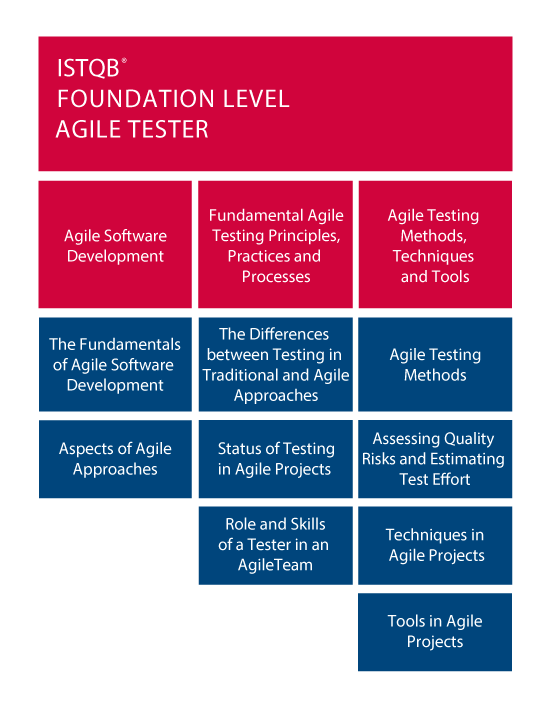
The following picture summarizes the contents of the Agile Tester syllabus:
Business Outcomes
An Agile Tester can...
- Collaborate in a cross-functional Agile team being familiar with principles and basic practices of Agile software development.
- Adapt existing testing experience and knowledge to Agile values and principles.
- Support the Agile team in planning test-related activities.
- Apply relevant methods and techniques for testing in an Agile project.
- Assist the Agile team in test automation activities.
- Assist business stakeholders in defining understandable and testable user stories, scenarios, requirements and acceptance criteria as appropriate.
- Work and share information with other team members using effective communication styles and channels.
In general, a Certified Tester Foundation Level – Agile Tester is expected to have acquired the necessary skills to working effectively within an Agile team and environment.
Learning Objectives
Certified agile testers should be able to demonstrate their skills in the following areas:
- The Fundamentals of Agile Software Development
- The different agile approaches
- The Differences between Testing in Traditional and Agile Approaches
- Testing in Agile Projects
- Roles and skills of a tester in Agile Projects
- Agile testing techniques and methods
- Assess product quality risks within an Agile project
- Estimate testing effort based on iteration content and quality risks
- Tools in Agile Projects
Syllabus
The Agile Tester is based on the ISTQB® Agile Tester Syllabus.
The International Software Testing Qualifications Board (ISTQB®) provides it to the national examination bodies for them to accredit the training providers and to derive examination questions in their local language.
Training providers will produce courseware and determine appropriate teaching methods for accreditation, and the syllabus will help candidates in their preparation for the examination.
To receive the Agile Tester certification, candidates must hold the Foundation Certificate.
Exam Structure
Similar to the Foundation Level Certification exam, the Agile Tester Certification exam will comprise of 40 multiple choice questions, with a pass mark of 65% to be completed within 60 minutes.
Participants that take the exam not in their spoken language, will receive additional 25% time, for a total of 75 minutes.
| Module | Number of questions | Exam length (minutes) | Exam length +25% (minutes) |
|---|---|---|---|
| Foundation Level Usability Testing | 40 | 60 | 75 |
- Register Interest
ISTQB - Usability Testing
Audience
The Foundation Level Usability Testing qualification is aimed at people who have already achieved a Foundation point in their careers in software testing and wish to develop further their expertise in Usability Testing.
Business Outcomes
Foundation Level Usability Testing candidates who have passed the Foundation Level "Usability Testing" syllabus exam should be able to accomplish the following Business Objectives:
- Understand the basic concepts of usability and usability testing.
- Identify and classify the severity of usability risks and potential accessibility violations in a given product at any stage of a development cycle.
- Cite relevant standards for usability, user experience, and accessibility and verify their implementation in a given product.
- Set up procedures so that stated usability, user experience and accessibility goals may be verified in practice for a given product.
- Design and monitor the implementation of a test plan for achieving stated usability, user experience and accessibility goals.
- Explain the rationale, process and results of usability, user experience and accessibility evaluations to non-specialist stakeholders.
Learning Objectives
Certified Foundation Level Usability Testing candidates should be able to demonstrate their skills in the following areas:
- Understand the concepts of usability, user experience and accessibility.
- Understand the objectives of usability, user experience and accessibility evaluation.
- Compare usability, user experience and accessibility evaluation.
- Understand the three approaches to usability, user experience and accessibility evaluation: Usability review, usability testing and quantitative user surveys for satisfaction measurement.
- Understand the differences between formative (qualitative) and summative (quantitative) usability evaluation.
- Understand the key elements of human-centered evaluation.
- Understand the human-centered design process.
- Understand the usability evaluation approaches that work well in agile software development lifecycles.
- Understand typical usability, user experience, and accessibility risks
- Analyze a given project at the design or evaluation stage, and identify the types of usability risks that are likely to occur
- Understand the general content and applicability of ISO usability standards and manufacturer guidelines to particular types of project/application
- Understand the general content and applicability of ISO 9241-171 (Software Accessibility) and the Web Content Accessibility Guidelines (WCAG) 2.0 to particular types of project and applications
- Understand the general content of accessibility legislation (UK Equality Act 2010 and Americans with Disabilities Act)
- Understand usability review as a method for evaluating usability, user experience and accessibility
- Understand the differences between informal usability review and expert usability review
- Analyze the usability aspects of a software application using the usability review method “heuristic evaluation” according to a checklist provided in the syllabus
- Understand the principal steps in the usability testing approach
- Understand the content of a usability test plan
- Understand the content of a usability test script
- Define a simple usability test task for a given project
- Understand considerations to be applied when deciding on a location for usability tests
- Understand the advantages and disadvantages of a usability test lab
- Understand the key activities in a usability test session
- Understand the procedure to apply for analyzing findings from a usability test
- Understand the classifications and ratings for usability findings
- Review a usability test report for a given project
- Understand how to overcome internal resistance to usability findings
- Apply a given list of best practices to report and communicate results
- Understand the quality control activities for a usability test
- Understand the most frequent and serious mistakes in usability testing
- Understand the purpose and approach adopted in user surveys
- Understand the principal content and objectives of the public user questionnaires SUS, SUMI and WAMMI
- Select appropriate method(s) for verifying and validating usability, user experience and accessibility in a given project
- Understand the principal tasks and responsibilities of the Usability Tester
- Understand the principal tasks and responsibilities of the Moderator and the Note-Taker
Syllabus
The Foundation Level Usability Testing qualification is aimed at people who have already achieved a Foundation point in their careers in software testing and wish to develop further their expertise in Usability Testing.
The Usability Testing is based on the Usability Testing Syllabus.
The International Software Testing Qualifications Board (ISTQB®) provides it to the national examination bodies for them to accredit the training providers and to derive examination questions in their local language.
Training providers will produce courseware and determine appropriate teaching methods for accreditation, and the syllabus will help candidates in their preparation for the examination.
To receive the Usability Testing certification, candidates must hold the Foundation Certificate.
Exam Structure
The Foundation Level Usability Testing exam is comprised of 40 multiple-choice questions, with a pass mark grade of 65% to be completed within 60 minutes. Participants that take the exam not in their spoken language, will receive additional 25% time, and will have 15 minutes more, or a total of 75 min.
| Module | Number of questions | Exam length (minutes) | Exam length +25% (minutes) |
|---|---|---|---|
| Foundation Level Usability Testing | 40 | 60 | 75 |
- Register Interest
ISTQB - Acceptance Testing
Audience
This acceptance testing qualification is aimed at anyone involved in software acceptance testing activities. This includes people in roles such as product owners, business analysts, testers, test analysts, test engineers, test consultants, test managers, user acceptance testers, and software developers.
The focus of the syllabus is on the concepts, methods and practices of collaboration between product owners / business analysts and testers in acceptance testing.
Content
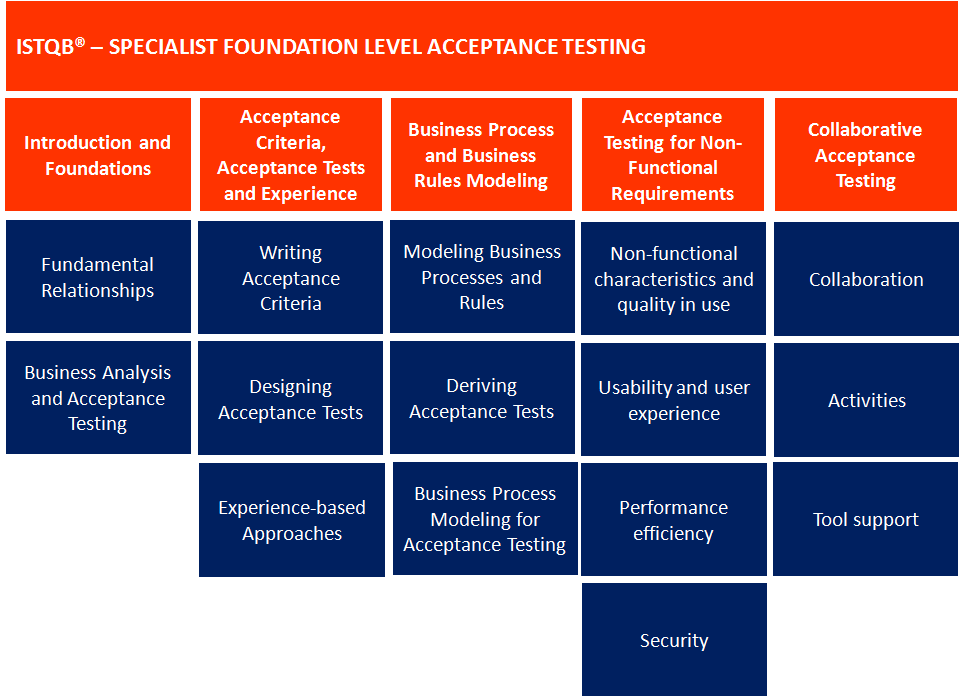
The following image demonstrates the contents of the Acceptance Testing syllabus:
Business Outcomes
IT professionals who have passed the “Acceptance Testing” syllabus exam should be able to accomplish the following Business Objectives.
For business analysts and product owners:
- Contribute to an organization’s acceptance testing activities by participating in the acceptance test design phase and supporting the alignment of the product with the business requirements.
- Contribute to an organization’s acceptance testing activities by participating in the acceptance test design phase and supporting the alignment of the product with the business requirements.
- Contribute to the quality of the acceptance testing process, including validation and verification of produced artifacts.
- Contribute to the definition of acceptance criteria during the requirements definition phase.
- Collaborate efficiently with business analysts and other stakeholders during all acceptance testing activities.
- Understand the business objectives, communicate with business units, and share common objectives for acceptance testing.
For testers:
Learning Objectives
IT professionals who have passed the “Acceptance Testing” syllabus exam should be able to demonstrate their skills in the following areas:
- Develop and review acceptance criteria for requirements and/or user stories in a collaborative way.
- Apply Acceptance Test Driven Development (ATDD) and Behavior Driven Development (BDD) techniques for a given scenario.
- Apply the Gherkin language for designing acceptance tests for a given scenario.
- Organize exploratory testing and beta testing session.
- Review business process/rule models specified in BPMN and DMN.
- Use business process/rule models specified in BPMN and DMN to create acceptance tests.
- Consider usability/user experience, performance efficiency and security in planning and performing acceptance testing.
- Collaborate efficiently with relevant stakeholders in acceptance testing activities including defect reporting and analysis and test status reporting.
- Select relevant tools for acceptance testing activities.
Syllabus
The Acceptance Testing is based on the Acceptance Testing Syllabus The International Software Testing Qualifications Board (ISTQB®) provides it to the national examination bodies for them to accredit the training providers and to derive examination questions in their local language.
Training providers will produce courseware and determine appropriate teaching methods for accreditation, and the syllabus will help candidates in their preparation for the examination.
To receive the Acceptance Testing certification, candidates must hold the Foundation Certificate.
To receive the Performance Testing certification, candidates must hold the Foundation Certificate.
Exam Structure
The Foundation Level Acceptance Testing exam is comprised of 40 multiple-choice questions, with a pass mark grade of 65% to be completed within 60 minutes. Participants that take the exam not in their spoken language, will receive additional 25% time, for a total of 75 minutes.
| Module | Number of questions | Exam length (minutes) | Exam length +25% (minutes) |
|---|---|---|---|
| Foundation Level Acceptance Testing | 40 | 60 | 75 |
- Register Interest
ISTQB - Certified Tester Foundation Level Performance Testing
Audience
The Foundation Level Performance Testing qualification is aimed at people who already hold the Software Testing Foundation and wish to develop further their expertise in Performance Testing.
Content
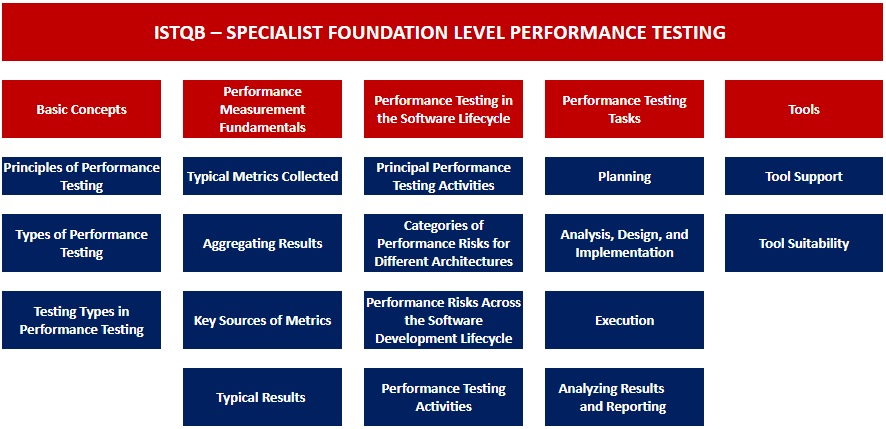
The following image demonstrates the contents of the Performance Testing syllabus:
Business Outcomes
Foundation Level Performance Testing candidates who have passed the Foundation Level “Performance Testing” syllabus exam should be able to accomplish the following Business Objectives:
- Understand the basic concepts of performance efficiency and performance testing
- Define performance risks, goals, and requirements to meet stakeholder needs and expectations
- Understand performance metrics and how to collect them
- Develop a performance test plan for achieving stated goals and requirements
- Conceptually design, implement, and execute basic performance tests
- Analyse the results of a performance test and state implications to various stakeholders
- Explain the process, rationale, results, and implications of performance testing to various stakeholders
- Understand categories and uses for performance tools and criteria for their selection
- Determine how performance testing activities align with the software lifecycle
Learning Objectives
Certified Foundation Performance Testers should be able to demonstrate their skills in the following areas:
- Understand the basic concepts of performance efficiency and performance testing
- Understand the principles of performance testing.
- Recognize the different types of performance testing.
- Recall testing types in performance testing.
- Understand the concept of load generation.
- Give examples of common failure modes of performance testing and their causes.
- Understand the typical metrics collected in performance testing.
- Explain why results from performance testing are aggregated.
- Understand the key sources of performance metrics.
- Recall the typical results of a performance test.
- Understand the principal performance testing activities.
- Explain typical categories of performance risks for different architectures.
- Analyze performance risks for a given product across the software development lifecycle.
- Analyze a given project to determine the appropriate performance testing activities for each phase of the software lifecycle.
- Derive performance test objectives from relevant information.
- Outline a performance test plan which considers the performance test objectives for a given project.
- Create a presentation that enables various stakeholders to understand the rationale behind the planned performance testing.
- Give examples of typical protocols encountered in performance testing.
- Understand the concept of transactions in performance testing.
- Analyze operational profiles for system usage.
- Create load profiles derived from operational profiles for given performance objectives.
- Analyze throughput and concurrency when developing performance tests.
- Understand the basic structure of a performance test script.
- Implement performance test scripts consistent with the plan and load profiles.
- Understand the activities involved in preparing for performance test execution.
- Understand the principal activities in running performance test scripts.
- Analyze and report performance test results and implications.
- Understand how tools support performance testing.
- Evaluate the suitability of performance testing tools in a given project scenario.
Syllabus
The Performance Testing is based on the Performance Testing Syllabus.
The International Software Testing Qualifications Board (ISTQB®) provides it to the national examination bodies for them to accredit the training providers and to derive examination questions in their local language.
Training providers will produce courseware and determine appropriate teaching methods for accreditation, and the syllabus will help candidates in their preparation for the examination.
To receive the Performance Testing certification, candidates must hold the Foundation Certificate.
Exam Structure
The Foundation Level Performance Testing exam is comprised of 40 multiple-choice questions, with a pass mark grade of 65% to be completed within 90 minutes. Participants that take the exam not in their spoken language, will receive additional 25% time, for a total of 113 minutes.
| Module | Number of questions | Exam length (minutes) | Exam length +25% (minutes) |
|---|---|---|---|
| Foundation Level Performance Testing | 40 | 90 | 113 |
- Register Interest
ISTQB - Mobile Application Testing
Audience
The Foundation Level Mobile Application Testing qualification is aimed at people who have already achieved a Foundation point in their careers in software testing and wish to develop further their expertise in Mobile Application Testing.
content
The following image demonstrates the contents of the Mobile Application Testing syllabus:
Business Outcomes
Certified Mobile Application Testers who have passed the Foundation Level “Certified Mobile Application Testing” exam should be able to accomplish the following Business Objectives:
- Understand and review business and technology drivers for mobile apps in order to create a test strategy
- Identify and understand the key challenges, risks and expectations associated with testing a mobile application
- Apply test types and levels specific to mobile applications.
- Apply common test types, such as those mentioned in ISTQB® Certified Tester Foundation Level syllabus 2018, in the mobile specific context.
- Carry out the activities required specifically for mobile application testing as part of the main activities of the ISTQB® test process.
- Identify and use suitable environments and appropriate tools for mobile application testing.
- Understand methods and tools specifically to support mobile application test automation.
Learning Objectives
Certified Mobile Application Testers should be able to demonstrate their skills in the following areas:
- Describe how available mobile analytics data can be used as input for the test strategy and the test plan.
- Distinguish between various business models for mobile applications.
- Recall different types of mobile devices.
- Distinguish between different types of mobile applications.
- Distinguish between general architecture types of mobile applications.
- Apply characteristics and specifics of the mobile market in preparing a test strategy.
- Give examples of the challenges associated with testing mobile applications.
- Describe how risks specific to mobile applications may be mitigated.
- Describe device-specific features and hardware which should be considered for testing.
- Prepare tests for the app's compatibility with screen sizes, aspect ratio, and screen density.
- Describe how tests can show the potential effects of device overheating on the system under test.
- Recall different test types for testing of the various input sensors used in mobile devices.
- Recall tests to be run for various input methods.
- Describe how tests can reveal user interface issues when changing screen orientation.
- Prepare tests for an app using typical mobile device interrupts.
- Prepare tests for changing the access permissions to the device features requested by the app.
- Prepare tests to verify the impact of an app on a device’s power consumption and the impact of its power state on the app.
- Prepare tests for the handling of notifications by the system under test.
- Describe how tests can verify correct functionality of quick-access links.
- Prepare tests for the impact on an app of the user preference settings provided by an operating system.
- Distinguish between different tests required for native, web and hybrid applications.
- Recall tests required for apps which are available on multiple platforms or operating system versions.
- Recall tests required for co-existence and interoperability with other apps.
- Summarize the tests for connectivity testing, including those across networks, when using Bluetooth and when switching to flight mode.
- Prepare installability tests for mobile apps.
- Prepare stress tests for mobile apps.
- Give examples of security issues related to mobile apps.
- Recall time and resource behavior considerations for mobile apps.
- Prepare usability tests for mobile apps.
- Recognize the type of tests required for database testing of mobile apps.
- Summarize the tests required for internationalization (globalization) and localization testing of mobile apps.
- Summarize the need for accessibility testing in mobile application testing.
- Describe the additional test levels, such as field testing, and the associated extra activities required for effective mobile application testing.
- Describe the tests required for carrying out application store approval for publishing apps.
- Recall session-based test management, personas, and mnemonics in the context of exploratory mobile testing.
- Describe the usage of tours and heuristics as exploratory techniques for mobile application testing.
- Make use of a mobile specific tour (such as the Feature tour) to test a mobile app.
- Match the test process, as described in ISTQB® Certified Tester Foundation Level syllabus, to the needs of mobile application testing.
- Describe the approaches to testing at each test level, specific to mobile application testing.
- Recall the development environments used for mobile application development.
- Recall some of the common tools supplied as part of application development platforms.
- Understand the differences between emulators and simulators.
- Describe the use of emulators and simulators for mobile application testing.
- Distinguish between various approaches to set up a test lab.
- Distinguish between common automation approaches and frameworks for mobile application testing.
- Describe various automation methods for testing mobile apps.
- Recall the various parameters to be considered during the evaluation of mobile testing automation tools.
- Distinguish between common approaches of creating test labs with advantages and disadvantages with respect to test automation.
Syllabus
The Mobile Application Testing is based on the Mobile Application Testing Syllabus
The International Software Testing Qualifications Board (ISTQB®) provides it to the national examination bodies for them to accredit the training providers and to derive examination questions in their local language.
Training providers will produce courseware and determine appropriate teaching methods for accreditation, and the syllabus will help candidates in their preparation for the examination..
To receive the Mobile Application Testing certification, candidates must hold the Foundation Certificate.
Exam Structure
The Foundation Level Mobile Application Testing exam is comprised of 40 multiple-choice questions, with a pass mark grade of 65% to be completed within 60 minutes. Participants that take the exam not in their spoken language, will receive additional 25% time, for a total of 75 minutes.
| Module | Number of questions | Exam length (minutes) | Exam length +25% (minutes) |
|---|---|---|---|
| Foundation Level Mobile Application Testing | 40 | 60 | 75 |
- Register Interest
A4Q - Practical Tester
A4Q Practical Tester
The A4Q Practical Tester application is designed for a seamless, student-focused learning experience. Its intuitive interface and expert AI guidance bridge the critical gap between theoretical knowledge and the hands-on application of essential testing techniques. Enhance your skillset and gain the proficiency valued by training providers and employers.
Practice Core Testing Techniques
Core testing techniques form the foundation of effective quality assurance. The app provides guided scenarios that let you apply concepts like boundary value analysis and equivalence partitioning.
concepts like boundary value analysis and equivalence partitioning.
The A4Q Practical Tester is a revolutionary AI-based solution to developing and embedding software testing skills:
The powerful AI-driven A4Q Practical Tester application accelerates learning with real-world scenarios and comprehensive feedback mechanisms. The A4Q Practical Tester certification exam uniquely validates your know-how and verifies your practical ability. The scheme has a practical approach by moving from multiple-choice to open-text exams.
Master in-demand practical testing skills
The software testing industry requires more than just textbook knowledge. The A4Q Practical Tester leverages the power of AI and expertly curated content to offer a comprehensive and practical learning experience. The interactive modules, hands-on exercises, and dynamic feedback will deepen your understanding, enabling you to apply core testing principles and techniques confidently. The A4Q Practical Tester will equip you with the in-demand skills employers need and help you work in software testing. Showcase your practical know-how Unlike standard knowledge-based multiple-choice exams, the A4Q Practical Tester exam assesses your competency. To succeed in the exam, you must correctly apply testing techniques and create test cases, defect reports, and test plans. Holders of the A4Q Practical Tester certification have demonstrated they can utilize their testing knowledge in real-world scenarios.
Career Development
Whether you are new to testing or an experienced software tester, the A4Q Practical Tester equips you with the practical skills and knowledge that are in high demand by today’s software development teams. It is also ideal for anyone who has already attained a qualification in software testing, including the ISTQB® Certified Tester Foundation Level certification, and who now wants to validate they can practically apply their knowledge.
What you will learn
When starting the A4Q Practical Tester, the A4Q team surveyed hundreds of test managers and many training providers on what they expect from a tester certification. The feedback was clear: they all prefer a practical approach for training and exams. The focus should go from knowledge-based to skills- and competence-based training. As a result, the A4Q Practical Tester is structured around practical objectives that span various software testing techniques. They complement the ISTQB® Certified Tester Foundation Level core body of knowledge. You will learn how to:
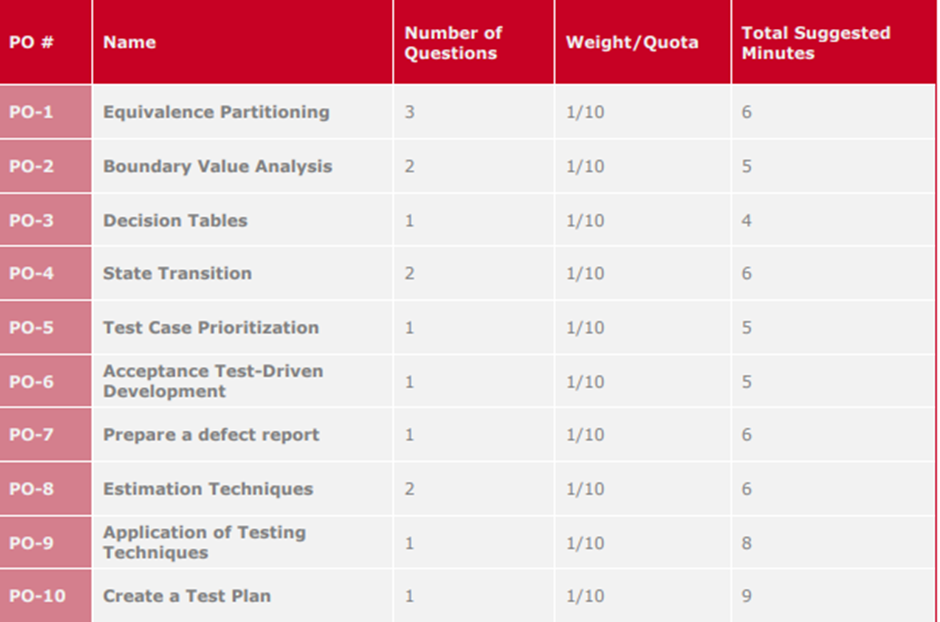
- Testing Techniques -
- Estimation Techniques -
- Identify & Address Issues -
- Create Effective Test Plans -
A4Q Practical Tester: Exam Details
The A4Q Practical Tester certification is aligned with the ISTQB® Certified Tester Foundation Level and the ISTQB® Glossary, ensuring a solid foundation in testing principles, techniques, and approaches.
Recommended Prerequisites
The A4Q Practical Tester is closely aligned with the ISTQB® certification scheme and uses the same glossary terms and wording. To gain the most benefit from the A4Q Practical Tester, the ISTQB® Certified Tester Foundation Level (CTFL) certification is highly recommended. However, holding the ISTQB® CTFL is not a prerequisite for passing the A4Q Practical Tester exam.
Exam Structure
The A4Q Practical Tester certification exam is based on the A4Q Practical Tester syllabus. Candidates are assessed against the “Practical Objectives” and must demonstrate their ability to effectively and accurately apply techniques and approaches. The assessment format is open text (the exam does not include multiple choice questions); Assessors will look for comprehensive and complete responses that align with the syllabus.
Exam Preparation
The A4Q Practical Tester app is a powerful learning tool supporting exam preparation. Candidates can also participate in an instructor-led A4Q Practical Tester training course, where they are guided through the syllabus using the learning tool to reinforce their skills development.
The A4Q Practical Tester provides a roadmap for learners to develop a comprehensive toolkit of testing skills applicable to real-world situations. The A4Q Practical Tester complements the ISTQB® Certified Tester Foundation Level 4.0 (CTFL 4.0).
To Register for A4Q Practical Tester AI learning
To Register for A4Q Practical Tester Exam go to
Not sure which course to choose?
Speak to a training expert for advice if you are unsure of what course is right for you.
Give us a call on +234 703 368 7987 or click below to enquire.
Enquire nowYour privacy & cookies!
Like many websites we use cookies. We care about your data and experience, so to give you the best possible experience using our site, we store a very limited amount of your data. Continuing to use this site or clicking “Accept & close” means that you agree to our use of cookies. Learn more about our privacy policy and cookie policy cookie policy.